| Origin | Madagascar |
|---|---|
| Family | Euphorbiaceae |
| Exposure | |
| Watering | Regular (every 10 days) from spring to late summer. Check that the earth is completely dry before watering again. In winter, water sporadically to prevent the plant from wilting. Suspend watering if the plant loses its leaves Regular (every 10 days) from spring to late summer. Check that the earth is completely dry before watering again. |
| Fertilization | Euphorbiaceae |



Euphorbia bongolavensis Ø 16
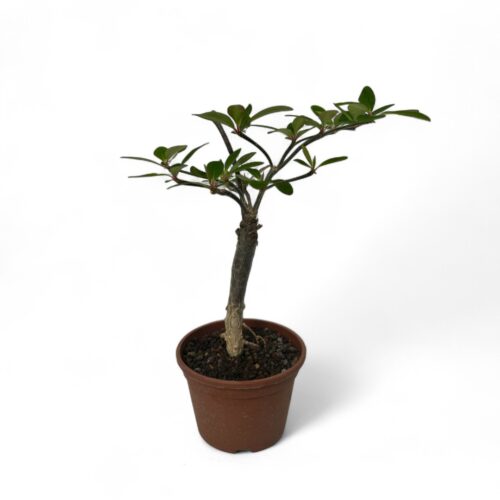
The stylised tree with geometric charm
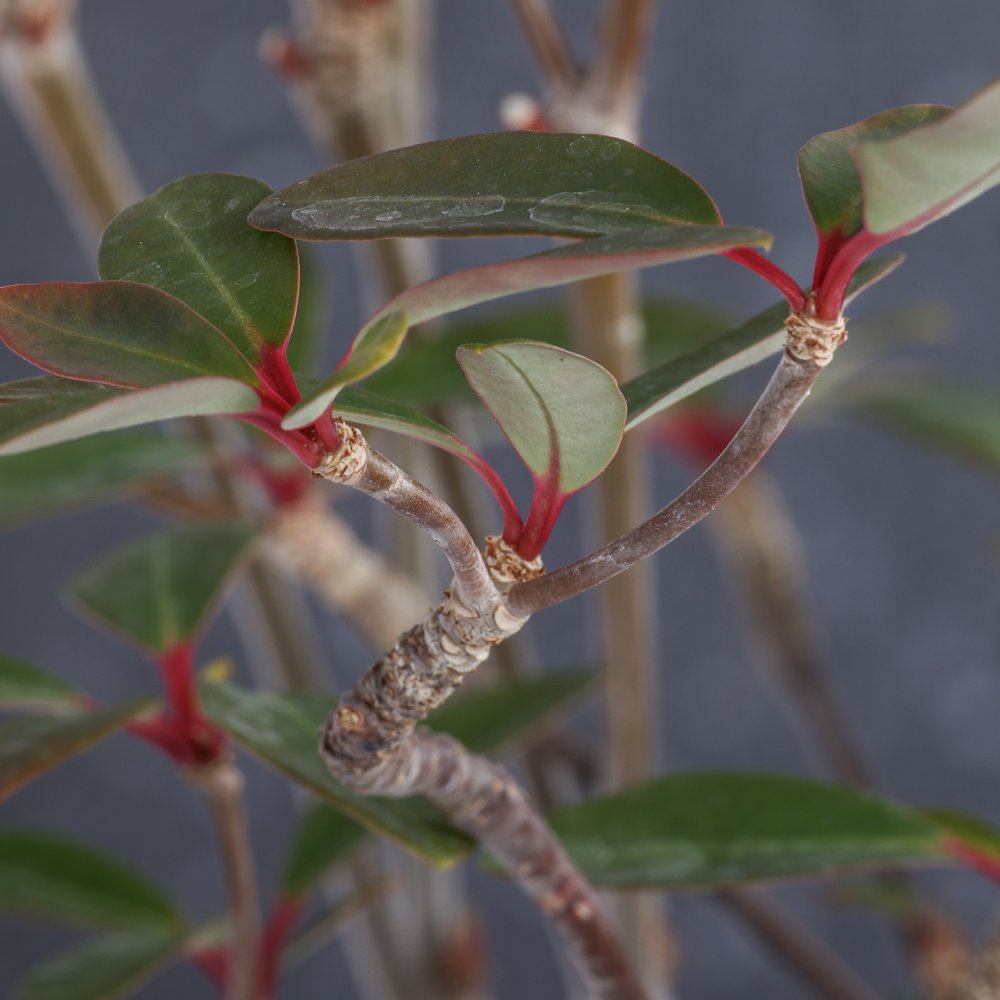
A extremely rare high‑collector succulent. Characterised by vertical woody stems almost devoid of leaves, it develops at the tips a tuft of lanceolate, bright green leaves, giving it the appearance of a small stylised tree – a unique piece of botanical art. Its uniqueness lies in its geometric growth and the bareness of its branches, interrupted only by the striking rosettes of apical leaves. The leaves, dark green at the base, change hue depending on the light they receive. This phenomenon tints the leaf edges and lower veins in shades ranging from bright pink to deep burgundy.
Exposure: prefers bright but filtered light. Direct morning or late‑afternoon sun is well tolerated, but during the central hours of the day it is best to protect it to prevent leaf scorch. The more light it receives, the more intense and vibrant the pink and burgundy edges will become.
Watering: during the growing season (spring–summer), water regularly but sparingly, allowing the substrate to dry out completely between waterings. In autumn, gradually reduce watering; in winter, withhold water almost entirely, only lightly moistening the soil every 4‑6 weeks to prevent the roots from completely drying out.
Soil type: needs an ultra‑well‑draining mix, composed of succulent soil, coarse sand, pumice, and a little volcanic grit in equal parts. The addition of about 10% well‑decomposed organic matter is appreciated but not essential.
Fertilising: from April to September, apply a specific low‑nitrogen fertiliser for succulents, diluted to one‑quarter of the recommended strength, every 3‑4 weeks. Cease completely in autumn and winter.
Flowering: in summer, at the stem tips, small yellowish‑green cyathia (typical Euphorbia inflorescences) appear – discreet yet very elegant. Flowering is encouraged by a cool, dry winter and good light exposure.
Did you know? The white milky sap that oozes from cuts is toxic and irritating – always handle with gloves. In the wild, this species can reach 2‑3 metres in height, but in pots it grows slowly and remains compact, making it ideal for indoor or greenhouse cultivation. It is a plant that lives for decades and becomes more fascinating with age, developing increasingly twisted and sculptural branches.
Not difficult to grow, it only requires attention to overwatering and cold temperatures. With just a little care, it will become the centrepiece of your botanical collection, admired for its minimalist elegance and rarity.
Not grafted
Code 1699
€150,00
Availability: 3 in stock