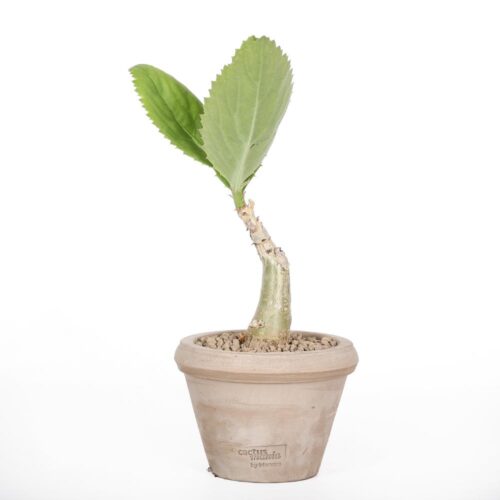
| Origin | Namibia |
|---|---|
| Family | Vitaceae |
| Exposure | |
| Watering | Water every 3-4 days only in the vegetative period. |
| Fertilization | Vitaceae |

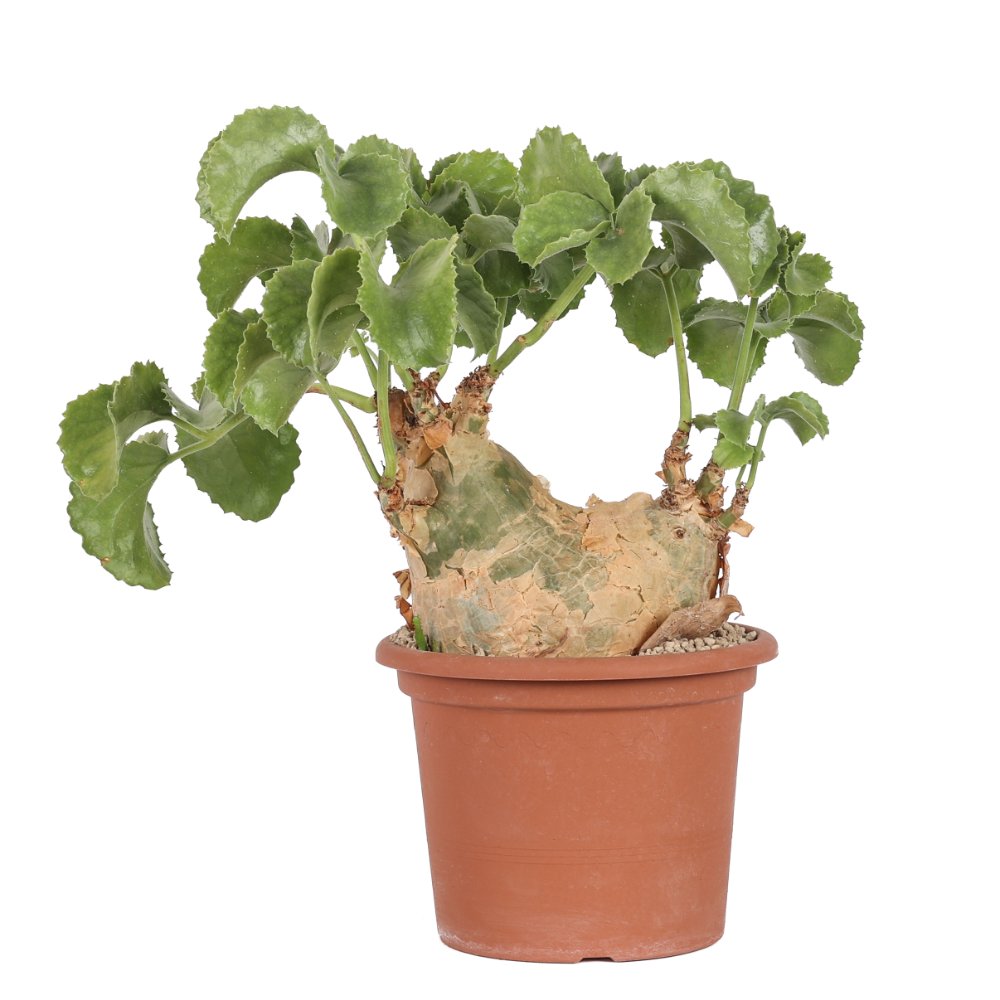



Cyphostemma uter Ø 25
The masterful caudiciform from southern Africa
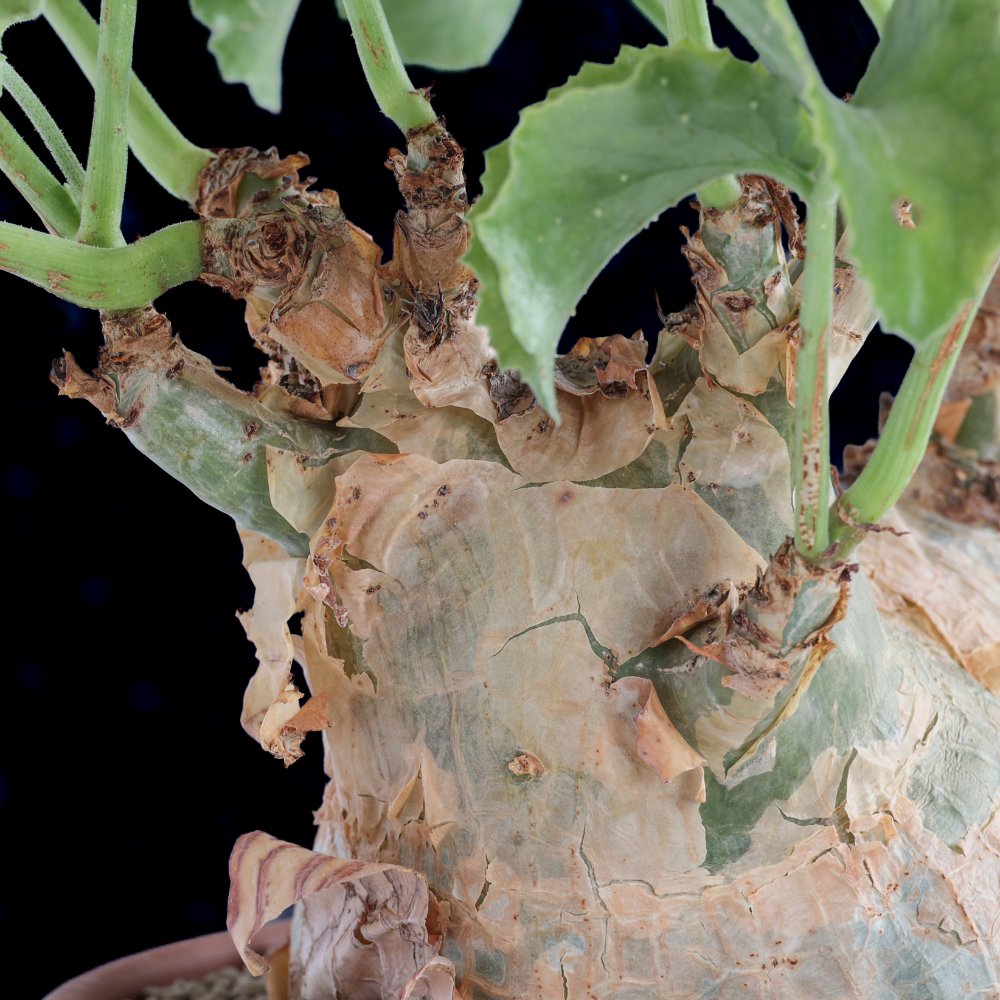
Considered one of the most majestic, bizarre, and sought-after caudiciform trees in the world. Native to the most remote and arid regions of Angola and Namibia, Cyphostemma uter develops an imposing succulent trunk (pachycaul) shaped like a flask or an upside-down bottle, topped with large, fleshy, serrated leaves of prehistoric charm. Its smooth, silvery bark peels over time into thin, translucent, papery veils. A monumental showpiece of the highest prestige, destined to become the crown jewel of any advanced collection.
Growing notes
- Exposure: full sun or very bright filtered light. Indoors, place it in front of a south- or west-facing window. It tolerates intense heat well, but in summer protect it from the harshest midday rays to prevent leaf scorch.
- Watering: in spring and summer, water generously but allow the substrate to dry out completely between waterings. In autumn, gradually reduce; in winter, withhold water almost entirely (only a light sip every 4–6 weeks to prevent root dehydration).
- Soil type: needs an extremely well-draining mix: 60% inert material (pumice, lava grit, coarse sand) and 40% universal potting soil. A good cactus or succulent mix, amended with gravel, is ideal.
- Fertilizing: during the growing season, apply a liquid fertilizer for succulents with low nitrogen and high potassium and phosphorus, once a month, diluted to half the recommended strength.
- Flowers: in summer, under optimal conditions, it produces small clusters of greenish or pale yellow flowers – inconspicuous but botanically fascinating. It rarely sets fruit in cultivation.
- Curiosities: the trunk stores huge water reserves, allowing it to survive extremely long droughts. It is a very slow-growing plant, and a specimen of this size may be several decades old, if not over a century. In the wild it is protected, so every cultivated plant comes from authorised seeds or cuttings.
This extraordinary succulent plant naturally inhabits the rocky, desert slopes of south-western Africa, where rain is a rarity. In cultivation, it displays an overwhelming aesthetic personality. During the growing season (spring–summer), the top of the trunk produces a rosette of fleshy, deeply lobed and toothed leaves of a glaucous green that contrasts beautifully with the pale bark. With the arrival of autumn, the plant enters a deep dormancy, drops its leaves, and transforms into a minimalist, powerful natural sculpture. It is a slow-growing species with exceptional longevity.
Unique piece
Not grafted
Code 1736F
€550,00
Availability: 1 in stock