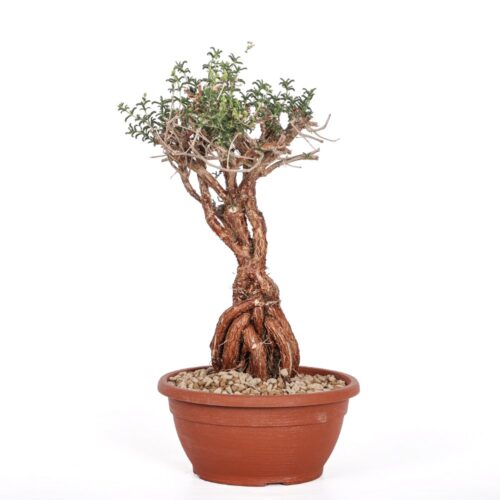
Mestoklema tuberosum
Sets and plants for sale in the Boutique.
A perennial succulent from the Aizoaceae family, native to the Eastern Cape provinces of South Africa, where it grows in dry shrublands and alluvial soils.
It is a plant highly valued by enthusiasts for its unusual appearance. Here are its main features:
- Tuberous roots (“caudex”): the most distinctive feature is the large tuberous taproot, which can be partially raised above the soil in cultivation to create a striking “bonsai” effect. This root, resembling a potato, is an adaptation for storing water and surviving drought.
- Growth habit and size: it is a small, highly branched shrub that can reach 30–70 cm in height. The branches are thin, woody, and have a dry appearance.
- Leaves: they are fleshy (succulent), thin, trigonous in shape (triangular in cross-section), and slightly curved at the tip. They are about 1–1.5 cm long and have a finely papillose surface.
- Flowers: it produces small flowers (about 8 mm in diameter) grouped in inflorescences, ranging in colour from yellow to orange, sometimes with reddish or purplish hues. Flowering occurs in summer, generally from February to June.
- Fruits: the fruits are capsules with 5 locules and do not have the typical “closing bodies” (rain dispersal mechanisms) of other Aizoaceae.